





A potential new threat to the health of honey bees in the region will be the topic of a presentation at University of Wisconsin-Stout.
Jim Burritt, a UW-Stout biology professor, will discuss his research results at 7 p.m. Monday, April 10, in room 110 of Jarvis Hall Science Wing, 410 10th Ave. E.
 The event is free and open to the public. Parking in UW-Stout lots is free after 4 p.m. Refer to the online campus guide for more information.
Burritt has led an ongoing honey bee research project at UW-Stout with students, and in December they published an article about a new bacterium they discovered. They named it Serratia marcescens strain sicaria.
The bacterium may be a factor in the high wintertime failure rate of honey bee colonies. “We believe this is important because most beekeepers in our area lose over half of their hives each winter. In Dunn County, the percentage of winter hive failure rates has been as high as 80 percent recently,” said Burritt, a longtime beekeeper.
Burritt’s research addresses infectious diseases in honey bees and the defense mechanisms bees use to resist disease. He will discuss evaluating honey bee health and new approaches he is taking to understand some of the challenges bees face.
The bacterium research, with student co-authors Anna Winfield, of Bloomer, and Jake Hildebrand, of Menomonie, was published Dec. 21 in PLOS One, a peer-reviewed, open-access, online publication for science and medicine research. The study is titled “Sepsis and Hemocyte Loss in Honey Bees.”
The honey bee project at UW-Stout is in its sixth year and has involved hundreds of UW-Stout students doing research in microbiology classes, courses within the applied science major and in locations beyond the classroom.
###
Photos
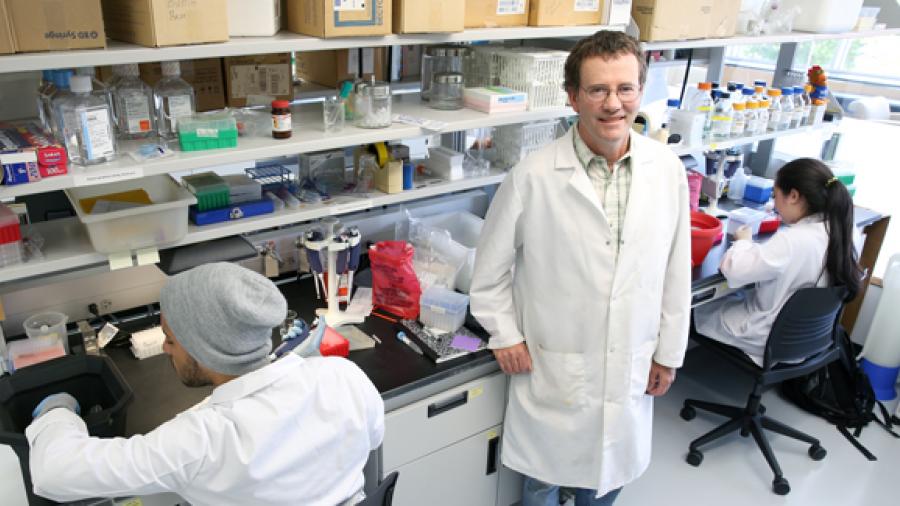
Biology Professor Jim Burritt works on the honey bee research project with students Matheus de Jesus and Viviane Oshima in a UW-Stout biotechnology lab. He will talk about the research, which found a potential new threat to bees, Monday, April 10, at UW-Stout.
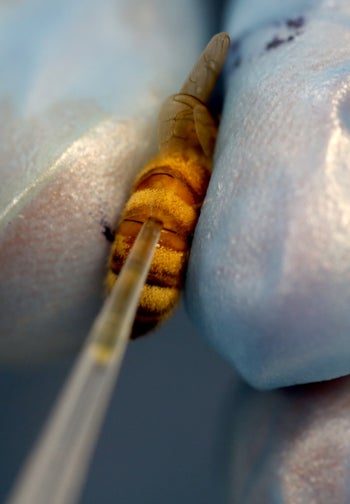
A UW-Stout student withdraws honey bee blood, hemolymph, in a biotechnology lab in Jarvis Hall Science Wing. A newly published UW-Stout study identifies a new bacterium that is killing honey bees in the region.