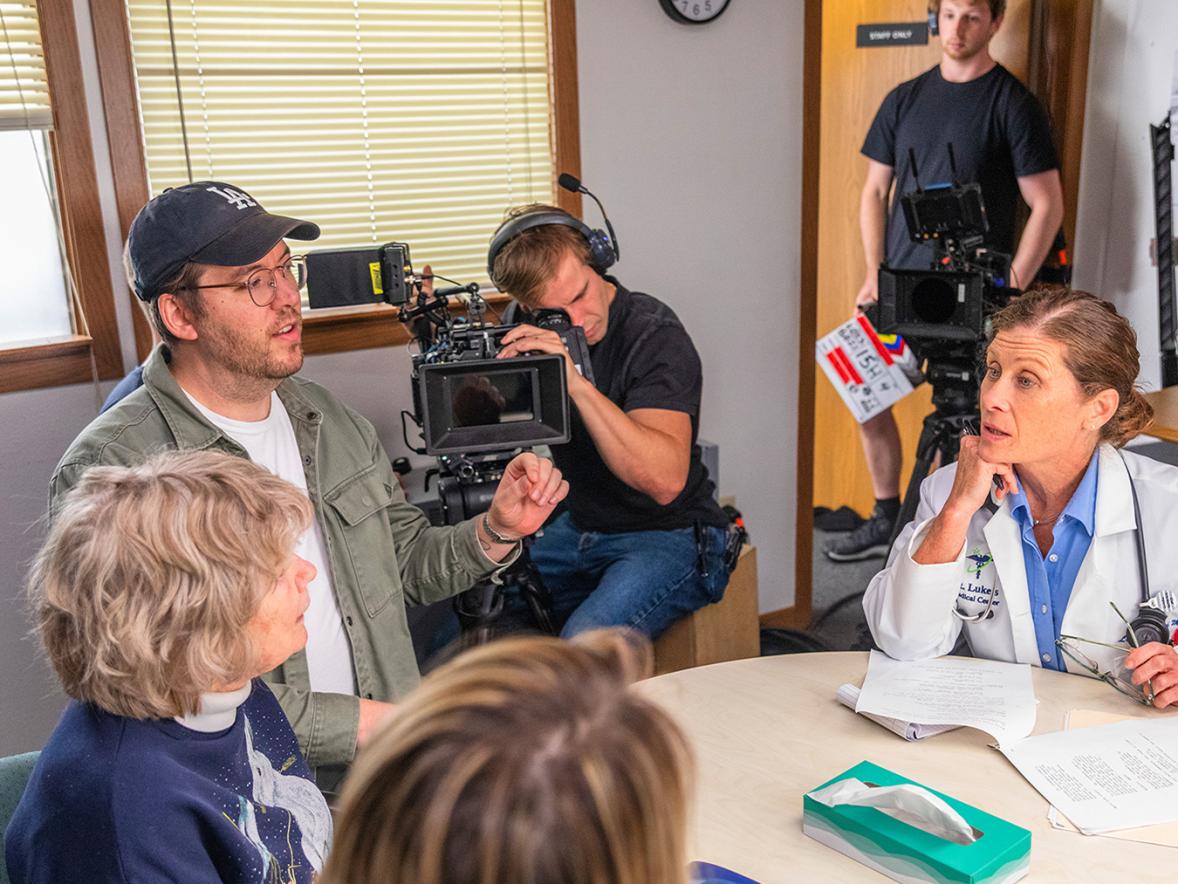






As an instructor of documentary filmmaking at UW-Stout, Assistant Professor Keif Oss’s professional interests in artificial intelligence (AI) filmmaking center on tools that can meaningfully inform and streamline the creative process.
Oss, program director of video production, is currently using AI to explore a conceptual documentary based on his grandfather’s World War II journal from the Battle of the Bulge. His grandfather, Jack Mooney, served in Company D, 405th Infantry Regiment, 102nd Infantry Division, in the European Theater of Operations.
“Until now, his experiences were things I could only imagine through black-and-white films and the few stories he shared. After he passed, I gained access to his journal, and the vivid detail of his writing reads almost like a film. I wanted to see whether AI could help me bring aspects of his experience back to life,” Oss said.
The Battle of the Bulge was fought in the Ardennes region of Belgium during World War II, from Dec. 16, 1944, to Jan. 25, 1945. It was the last major German assault on the Western Front, in an unsuccessful attempt to break Allied lines.
Just as he encourages students in his documentary courses, Oss used the AI tools Elicit and Perplexity as elevated forms of research support. Elicit surfaced research articles on troop movements and the broader context of the battle, while Perplexity helped confirm geographical details and historical images of the terrain.
These tools allowed Oss to map locations from his grandfather’s journal and cross-reference them with known Allied troop movements, giving him a clearer sense of where his grandfather may have been during the campaign.
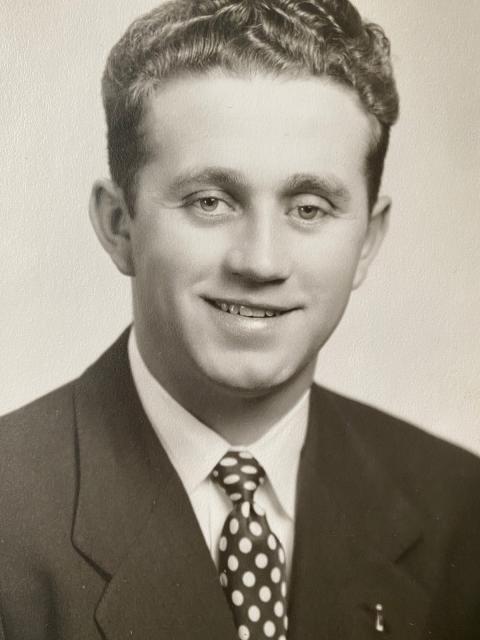
Using a photograph of his grandfather from 1952, Oss mapped his likeness into an AI engine and generated period-accurate still images of him in the European Theater. He used a combination of period stock photography, processes, and tools to generate initial stills in Midjourney, then brought them into Runway to create short live-action sequences.
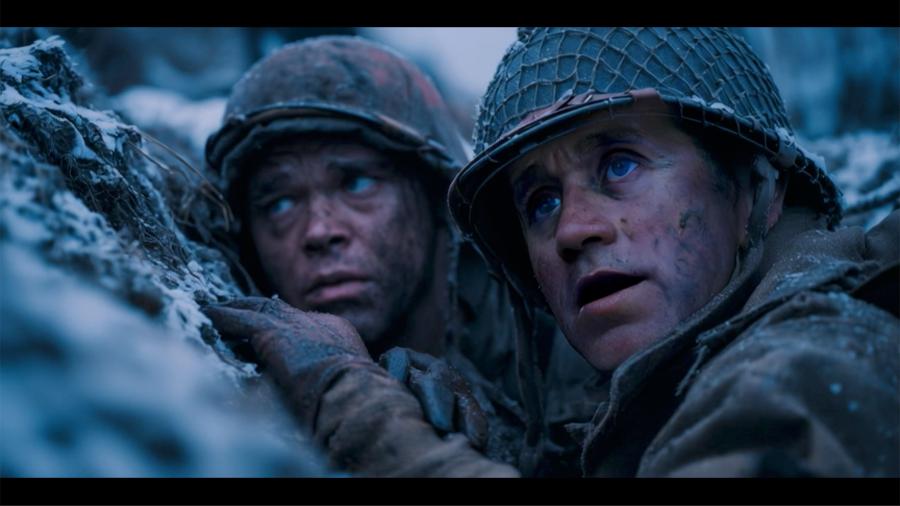
“The results, while clearly artificial, had an uncanny resemblance to how my grandfather might have looked as a young soldier. Sharing these with my family produced the same mix of fascination and emotional weight I felt while creating them,” Oss said. “For one scene – his account of being in a foxhole in a beet field in Belgium during a German assault – I combined his descriptions with uploaded reference photos of uniforms and landscapes.”
During the assault, his grandfather’s unit was taken by German soldiers wearing harvested officers’ clothing from American troops. “He and one other soldier escaped. Otherwise, the whole unit was captured. He didn't know it until later,” Oss explained.
Oss also attempted to use AI handwriting tools to decipher difficult portions of the journal. “While some engines struggled with cursive without a training sample, the process helped clarify what AI can and cannot yet handle,” he said. “This project remains an ongoing personal hobby, and AI continues to be a meaningful part of my ability to study, visualize and interpret my grandfather’s experiences.”
A new Artificial Intelligence (AI) Assisted Film and Video Production course will launch at UW-Stout in summer 2026. The course, possibly a first-of-its-kind in the Universities of Wisconsin, was developed by Oss and fellow faculty members Jonny Wheeler and Co O’Neill. Students in the course will produce a short narrative film, using AI tools from pre-production concepts to completion.