




The term “3D printing” may conjure images of a boxy machine whirring away to create plastic pieces for a hobbyist or small prototypes for factories. Yet additive manufacturing technology has evolved dramatically in recent years, with breakthroughs impacting numerous fields, including construction.
Today, 3D printers can extrude not only slender plastic filaments but also sturdy concrete to create entire structures – up to and including commercial and residential buildings.
UW-Stout Polytechnic is at the forefront of the 3D concrete printing (3DCP) revolution, becoming one of the first universities in the Midwest to acquire 3DCP technology through a strategic partnership with Alquist, a leader in the industry.
“This partnership with Alquist aligns directly with our mission to deliver applied, career-ready education,” Chancellor Katherine Frank said. “By bringing 3DCP technology and curriculum to our students, we’re preparing them to lead in a rapidly evolving construction and manufacturing landscape.”
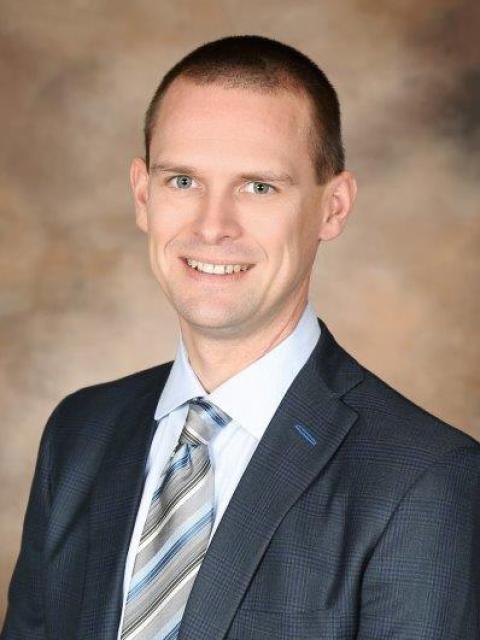
UW-Stout Polytechnic is integrating the cutting-edge equipment and curriculum from Alquist into its construction management, technology education, and industrial and product design programs. The relationship with Alquist will help build the workforce infrastructure required to scale robotic construction nationwide.
Among those who have taken part in on-campus 3DCP training is Senior Lecturer James Bunkelman (’00, ’20), president and CEO of Royal Construction in Eau Claire. Few universities or general contractors have access to such equipment, Bunkelman said.
“For industry and business to have a chance to provide input on how and where this technology fits into our daily business life, we need to be able to see and work with it,” he said. “Having access to it firsthand at Stout is the easiest way for us to figure out how this may help us. Labor shortages mean that we have to figure out how to do more with less, and technology like this a key part of the future of construction labor.”
Certificate program among first of its kind
The new technology has allowed UW-Stout Polytechnic to become one of the first educational institutions in the United States to create a 3D Concrete Printing Certificate program. The certificate program will boost workforce skills by providing foundational expertise for both undergraduate students and professionals looking to add high-demand skills to existing careers.
Associate Dean Jennifer Astwood, a professor of industrial and product design and associate dean of the College of Arts and Human Sciences who has coordinated the 3DCP project on campus, has developed the university’s curriculum and certificate program with Professor Monika Herrmann of the Robert F. Cervenka School of Engineering.
Astwood has also coordinated training sessions to expose business and industry representatives, faculty and students to the new technology.
“This summer, we worked on honing our skills with the 3DCP process and printing,” Astwood said. “It requires a lot of material consideration and environmental factors and time. We're getting stronger in our knowledge and more efficient in the process.”
UW-Stout Polytechnic is already planning how the new technology will fit into the future of the campus. The Universities of Wisconsin’s 2027-29 budget request includes funding for a new Built Environment Emerging Technologies Lab to advance the 3DCP lab as a center for emerging technologies in the built environment, providing hands-on, industry-aligned education and workforce training for Wisconsin residents interested in architecture, interior design, industrial and product design, and automation.
Preparation for adopting 3DCP technology began more than a year ago, with support from Associate Professor Kevin MacDonald and Assistant Professor Janelle Skoyen Hestekin, both from the construction management program. Astwood also credits Chancellor Frank and Professor Glendalí Rodríguez, the university’s former provost, for their strong support of the effort.
Polytechnic printing effort connects to university’s past
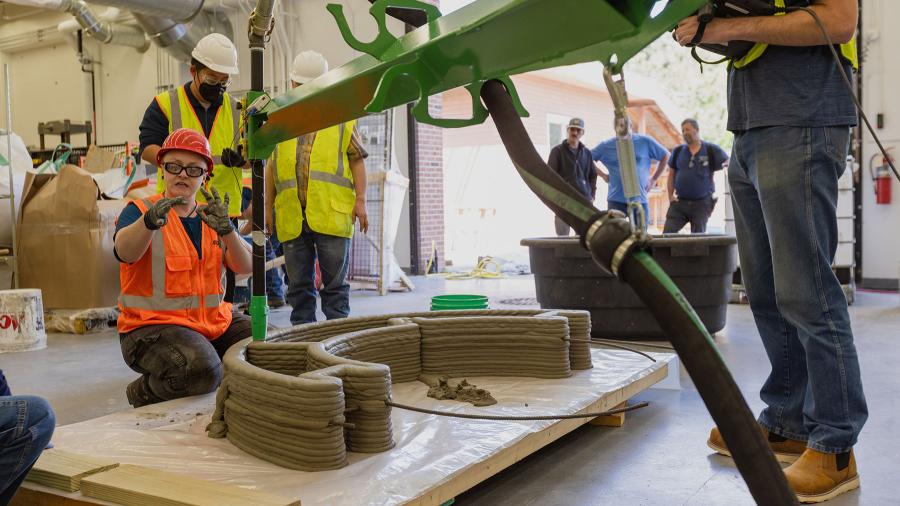
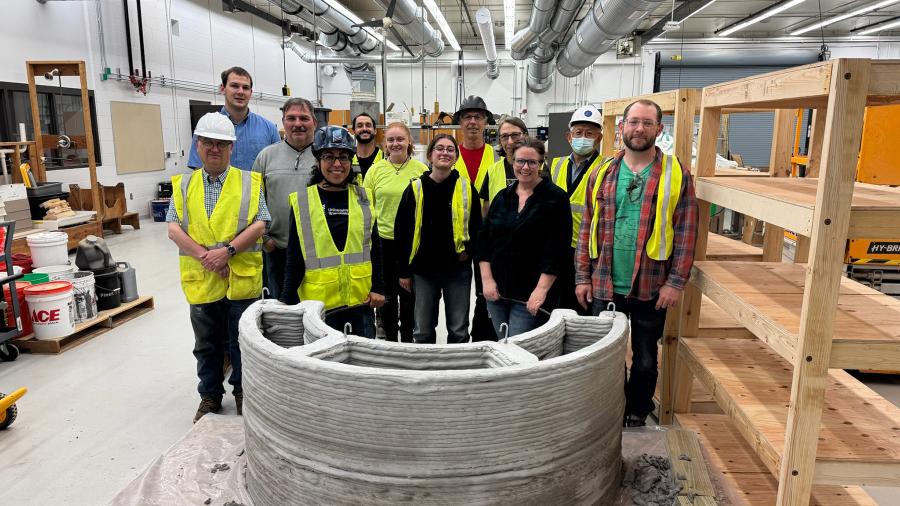
Just after spring semester, dozens of faculty members, students and business representatives gathered in the Jarvis Hall Technology Wing to learn how to use the concrete printer with the help of Alquist trainers.
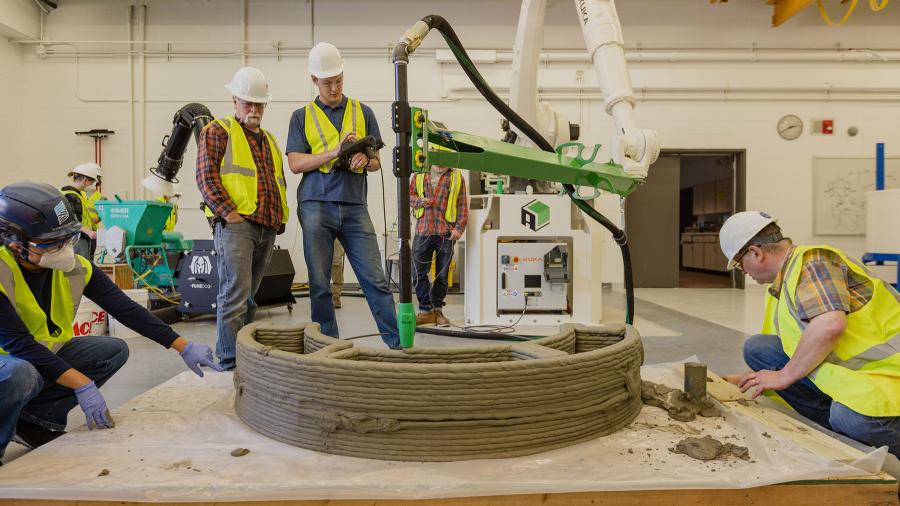
Concrete was mixed and pumped through an extrusion hose attached to a delivery boom held aloft by a robotic arm. As the arm moved, a print nozzle on the end of the boom looped around in a pre-defined pattern, laying a steady bead of wet concrete. As the shape grew, MacDonald and Associate Professor Dan Neubauer carefully added curved pieces of rebar to reinforce the structure. Others, including Astwood, used tools to smooth the still-wet concrete.
Before long, a large concrete planter had taken shape – a planter that is expected to find a home on campus soon. It’s just one relatively small example of what the 3DCP technology can do. Alquist’s printers have been used to create everything from commercial buildings for Walmart to affordable homes in partnership with Habitat for Humanity.
As it engages further with the technology, which was funded by the Wisconsin Economic Development Corp., UW-Stout Polytechnic has similar aspirations. “The long-term goal is that we’ll want to build houses and structures with this,” Astwood said.
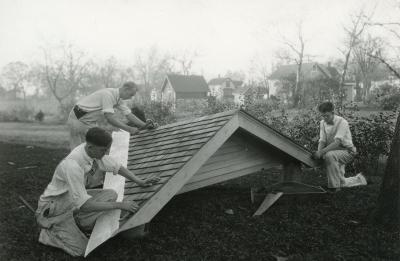
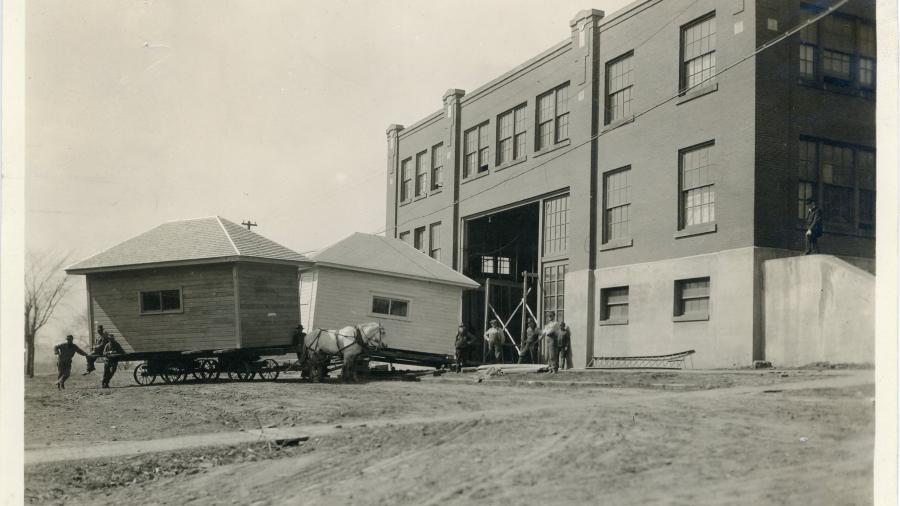
That would bring the university full circle: In the first half of the 20th century, students at what was then known as the Stout Institute applied their construction skills to the task of building houses for community residents. Between the 1910s and 1950s, as many as 35 to 40 houses were built by students in Stout carpentry classes. Some were built on-site around Menomonie, while others were built inside the since-demolished Ray Hall, then moved – first by horses, then by trucks – to foundations around the city. A century later, some of these charming cottages are still standing, providing another demonstration of the long-term impact of the polytechnic education provided by Stout for 135 years.
Just like moving these houses, preparing the university for 3DCP has been a big lift.
“This is a huge undertaking,” Astwood said. “The work this summer to create the curriculum and to gain expertise with the machinery and technology will ensure a strong future for this project. It takes a village to make this endeavor successful. We coordinated with multiple programs, including construction management, engineering, and industrial and product design.
“A special thank you goes to Monika Herrmann, Kevin MacDonald, Dan Neubauer, Janelle Skoyen-Hestekin, and Michael Miller,” she continued. “Not only were we working to become adept in the technology, we were also working to make sure that the technology was safe and effective to use. Thanks also goes to Brandon Dick, Jim Uhler and Paul Craig for their efforts in this area. We also couldn’t have gotten this project off the ground without the support of Xuedong Ding and Justin Utpadel.”