


Engineer the Power & Intelligence Behind Technology
From the processors inside robots and AI systems to the power electronics driving electric vehicles, modern technology runs on circuits and code designed together. UW-Stout Polytechnic’s ABET-accredited B.S. Computer & Electrical Engineering prepares you to design both, in labs from your first semester.
What Is the B.S. Computer & Electrical Engineering at UW-Stout Polytechnic?
B.S. Computer & Electrical Engineering is one engineering degree that combines electrical engineering and computer science, so graduates can design both the hardware and the software inside modern technology. The program is accredited by the Engineering Accreditation Commission of ABET. Students choose a concentration in computer engineering or electrical engineering and complete a required co-op or internship. New to the field? Read our guide to computer and electrical engineering careers.

Career-Defining Engineering Curriculum
UW-Stout Polytechnic's B.S. Computer & Electrical Engineering program will equip you with the knowledge, skills, and experiences to enhance regional and national industries. Our program focuses on building robust computer engineering expertise, grounded in the principles of electrical engineering and computer science. Featuring a calculus-based curriculum with a strong emphasis on mathematics and science, it progresses to encompass practical abilities in analysis and design, covering areas such as:
- Electrical Engineering
- Robotics
- Electronics
- Sensors & Actuators
- Wireless Communication
- Systems Engineering
- Mathematics
- Analysis & Design of Computer Systems
- Design of Hardware/Software Systems that Use Embedded Digital Processors

Program Overview
Pursue the Concentration or Minor That Meets Your Career Goals
All computer and electrical engineering students take the same courses for their first two years and declare a concentration by the start of junior year.
- Computer Engineering: Focuses on digital systems, computer architecture, embedded processors, networking, and the software that controls hardware. Typical roles include embedded systems engineer, firmware engineer, and computer hardware engineer.
- Electrical Engineering: Focuses on circuits, electronics, signals, control systems, sensors, and power. Typical roles include electrical design engineer, controls engineer, and test engineer.
Program graduates automatically fulfill the requirements for minors in Mathematics and Computer Science but must submit an Add or Change Minor form to the Achievement Center to formally declare a minor on their academic records. We also offer a minor in Advanced Automation.
STEM OPT Extension Advantage for International Students
Complete the Request Information form now to get detailed program insights and embark on your journey towards engineering excellence.
Request Information
ABET Engineering Accreditation

UW-Stout Polytechnic's B.S. Computer & Electrical Engineering program is accredited by the Engineering Accreditation Commission of ABET, under the commission’s General Criteria and Program Criteria for Electrical, Computer, Communications, Telecommunication(s), and Similarly Named Engineering Programs. Stout graduates meet the education requirement for professional engineer (PE) licensure in Wisconsin.
Industry-Experienced Faculty Instruction
Forget TA-taught classes and 200-person lectures. Building close relationships with our industry-experienced and academically accomplished computer and electrical engineering faculty will play a key role in your polytechnic education. Learn more about your future instructors!
Do More in Our Engineering Labs
Labs include two electronics labs, a capstone design and electromagnetics lab, an industrial control and automation engineering lab, and an electromechanics lab. The program distinctly prioritizes laboratory-based learning and student-led engineering design projects. It concentrates on developing hardware and software design skills for engineering systems that incorporate embedded digital processors, including microprocessors, microcontrollers, digital signal processors, and personal computers. As Wisconsin's only polytechnic university, we focus on:
- Hands-on Laboratory Projects
- Engineering Design Projects
- Real-World Challenges
- Employment Competitiveness
- Hardware & Software Development
- Active Learning
- Comprehensive Application Ability
- Innovation Abilities
Professional Internships in Computer & Electrical Engineering
Take your education into industry and earn while you learn through UW-Stout Polytechnic’s award-winning Cooperative Education & Internship Program (CEIP) and other placements. Unlike traditional internships, our professional paid and unpaid credit-earning experiences connect you with leaders in your field, including Fortune 500 employers, impactful non-profits and government agencies, to ensure you’re set up for success long before you graduate. More than a third of Stout students accept positions after graduation with their CEIP employer. Every computer and electrical engineering student completes at least one co-op or internship.
Recent Internship Employers
- 3M
- AT&T
- Gulfstream Aerospace Corporation
- Hewlett Packard Enterprise
- IBM
- Medtronic
- nVent
- Western Digital Technologies, Inc.
Select Internship Position Titles
- Automation Engineer Intern
- Controls Engineer Intern
- Electrical Characterization Intern
- Engineering Programming Intern
- Manageability Firmware Intern
- Software Engineer Intern
- Sustainable Product Development Intern
- Testing Engineer Intern
Engineering Student Projects & Capstones
The following video showcase provides an in-depth look at the design, and computer and electrical components of CEE student projects.
Click on the dropdown menu in the upper left-hand corner of the video to watch the seven videos. Or view the student project image gallery.

Graduate Ready to Solve Tomorrow's Engineering Challenges
Each year, Stout computer and electrical engineering graduates are among the most sought-after hires to enter the workforce, routinely beating out applicants from bigger schools for coveted hardware and software positions with major employers. Why? Everything you learn at Stout enhances the skills you'll use on day one of your career. Where others list their education, you’ll be able to identify your experience.
Recent Employers
- Aspen Technology and Open Systems International
- Collins Aerospace
- DigiKey Electronics
- EPIC
- General Dynamics Mission Systems
- Georgia-Pacific
- Graco Inc.
- Hewlett Packard Enterprise
- IBM
- Kohler Company
- Medtronic
- MotoCrane, LLC
- nVent
- Quanta Services, Inc.
- TruNorth Automation
- United Launch Alliance (ULA)
Discover More Degrees in Engineering
Application
To apply to this degree program, you need to apply to UW-Stout Polytechnic.
Financial Aid
Students who are attending another institution, but are planning to receive their degree from UW-Stout Polytechnic, may be eligible to receive aid from UW-Stout Polytechnic. In these cases, UW-Stout Polytechnic is considered the Home Institution and the other campus is considered the Visiting Institution.
Transfer Students
As a student in the Computer and Electrical Engineering program, you must have an aptitude for science and mathematics. We encourage you to take as many upper-level math and science courses in high school as possible, including mathematics through algebra and trigonometry, physics, and chemistry. Early development of computer skills is also very helpful.
Program Educational Objectives
The Computer and Electrical Engineering program develops computer engineers who are:
- in demand by employers
- recognized for their ability to apply engineering expertise
- recognized for their leadership and teamwork skills
- demonstrate an ability to learn and adapt to the changing environment created by societal and technical influences
- demonstrate continued career growth and professional development
Student Outcomes
UW-Stout Polytechnic B.S. Computer & Electrical Engineering graduates will possess:
- An ability to identify, formulate, and solve complex engineering problems by applying principles of engineering, science, and mathematics.
- An ability to apply engineering design to produce solutions that meet specified needs with consideration of public health, safety, and welfare, as well as global, cultural, social, environmental, and economic factors.
- An ability to communicate effectively with a range of audiences.
- An ability to recognize ethical and professional responsibilities in engineering situations and make informed judgments, which must consider the impact of engineering solutions in global, economic, environmental, and societal contexts.
- An ability to function effectively on a team whose members together provide leadership, create a collaborative and inclusive environment, establish goals, plan tasks, and meet objectives.
- An ability to develop and conduct appropriate experimentation, analyze and interpret data, and use engineering judgment to draw conclusions.
- An ability to acquire and apply new knowledge as needed, using appropriate learning strategies
Advisory Committee Members
| First Name | Last Name | Title | Organization |
|---|---|---|---|
| Kenan | Baltaci | Associate Professor | UW-Stout Polytechnic |
| Chris | Bendel | Associate Dean | UW-Stout Polytechnic |
| Devin | Berg | Interim ET Department Chair | UW-Stout Polytechnic |
| Dylan | Christopherson ('20) | Software Developer | IBM |
| Pratik | Deb | Senior Signal Integrity Engineer | Hewlett Packard Enterprise |
| David | Ding | CSTEMM Interim Dean | UW-Stout Polytechnic |
| Austin | Elsinger | Software Engineer | Digi-Key Electronics |
| Mike | Gerner | Business Manager | Kimball Solutions |
| Joel | Gotelaere | Test Solutions Engineering Manager | IBM |
| Robert | Harveland | Senior Program Manager | Benchmark Electronics |
| Jacob | Hillebrand ('20) | Electronic Systems Controls Senior Engineer | Cummins Inc. |
| Ryan | Holleran | Manufacturing Test | Extreme Engineering Solutions, Inc (X-ES) |
| Steve | Johnson | Software Manager | Benchmark Electronics |
| Connor | Johnson ('23) | Electrical Engineer | Aqua Aerobic Systems |
| Vedat | Kiray | Lecturer | UW-Stout Polytechnic |
| Al | Lainio | CEO | Digital R-E-D |
| Ryan | Laleman | Maintenance Manager | Nestle Health Science |
| Jeff | Leismer | Founder; CEO | Vibetech, Inc. |
| Robert | Livingston | Engineering Manager | Nestle Health Science |
| Cheng | Liu | Professor | UW-Stout Polytechnic |
| Mike | Maas | Engineering Director, Product Development | Bracco Medical Technologies |
| Steve | Martin | Master Technologist | Hewlett Packard Enterprise |
| Bennett | Miles | Electrical Control Engineering II | nVent |
| Trevor | Mumm | Alumni Representative | CEE Alumni |
| Brian | Pederson | Manager, Manufacturing Engineering | Midwest Manufacturing |
| Nick | Rinaldi | Manager, Electrical Engineering | Kohler Co. |
| Ken | Rost | President | Frost |
| Dave | Rush | Software Engineer | Hewlett Packard Enterprise |
| Easton | Sailer | Hardware/Electrical Engineer I | Hewlett Packard Enterprise |
| Emily | Schreiter | Instrumentation Technologist | UW-Stout Polytechnic |
| Wei | Shi | Associate Professor | UW-Stout Polytechnic |
| Ahmet | Turkmen | Professor; Program Director | UW-Stout Polytechnic |
| Ryan | Weinberger | Talent Acquisition Specialist | Benchmark Electronics |
| Yuan | Assistant Professor | UW-Stout Polytechnic | |
| Holly | Yuan | Professor; Program Director, B.S. Cybersecurity | UW-Stout Polytechnic |
| Student; Vice-President, IEEE | UW-Stout Polytechnic |
Frequently Asked Questions About Computer & Electrical Engineering at UW-Stout Polytechnic
Is UW-Stout Polytechnic’s B.S. Computer & Electrical Engineering ABET-accredited?
Yes. The program is accredited by the Engineering Accreditation Commission of ABET under the General Criteria and the Program Criteria for Electrical, Computer, Communications, Telecommunication(s), and Similarly Named Engineering Programs.
Can I become a licensed professional engineer (PE) with a UW-Stout Polytechnic computer and electrical engineering degree?
Yes. Wisconsin requires a bachelor’s degree from an engineering program accredited by ABET’s Engineering Accreditation Commission (EAC) for PE licensure, and this program meets that requirement. Graduates then pass the Fundamentals of Engineering (FE) exam, gain qualifying experience, and pass the PE exam, as outlined by the Wisconsin Department of Safety and Professional Services. Most computer and electrical engineering roles don’t require a PE license, so few graduates pursue one.
What is the difference between the computer engineering and electrical engineering concentrations?
Both share a foundation in circuits, digital logic, programming, and embedded processors. The computer engineering concentration goes deeper into computer architecture, networking, and hardware-software design; the electrical engineering concentration goes deeper into electronics, signals, controls, and power. Both lead to the same ABET-accredited B.S. degree.
When do I choose my concentration in the B.S. Computer & Electrical Engineering?
All computer and electrical engineering students take the same courses for their first two years. Concentration courses come in the junior and senior years, and students declare their concentration by the start of junior year.
Do computer and electrical engineering graduates really earn two minors automatically?
Yes. Graduates fulfill the requirements for minors in Mathematics and Computer Science. To have them appear on your academic record, submit an Add or Change Minor form to the Achievement Center.
What will I build in UW-Stout Polytechnic’s computer and electrical engineering labs?
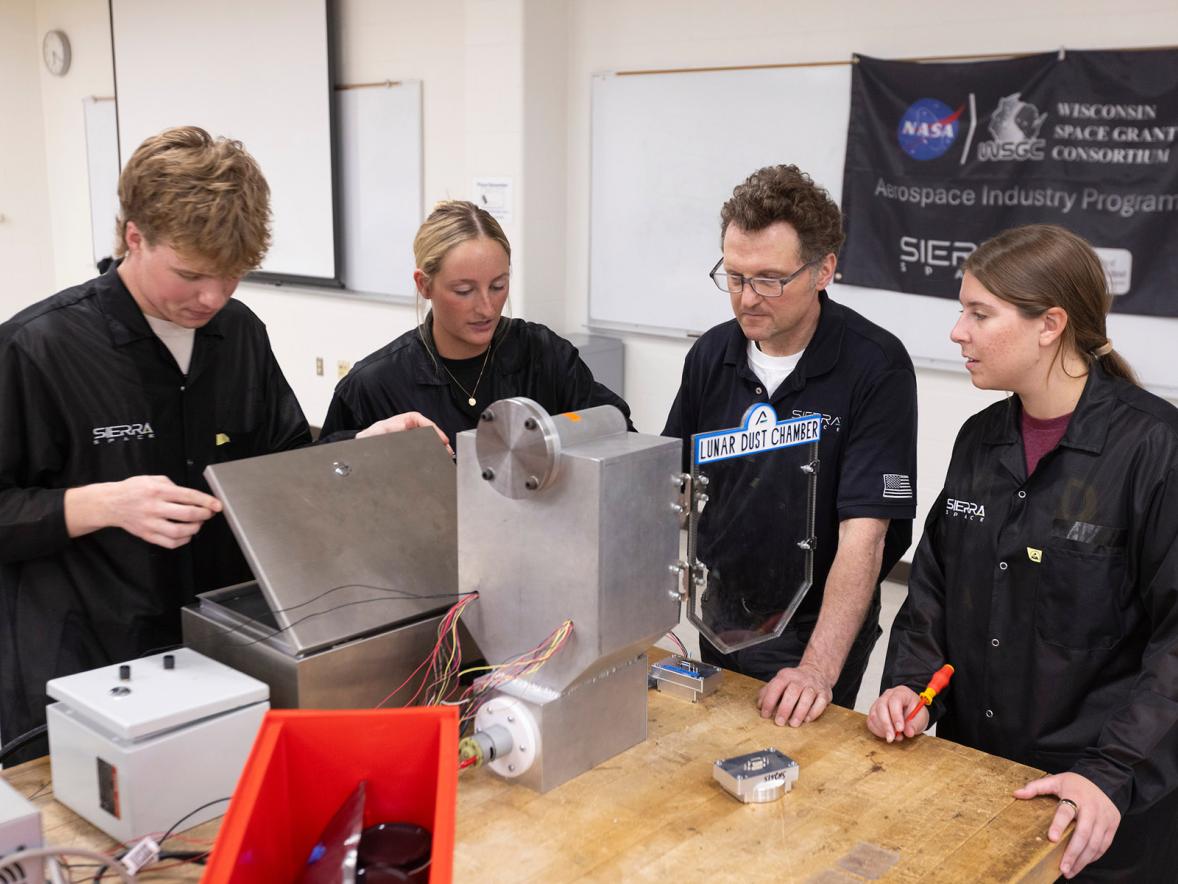
From the first semester, students design hardware and software for systems that use microprocessors, microcontrollers, and digital signal processors, in two electronics labs, a capstone design and electromagnetics lab, an industrial control and automation engineering lab, and an electromechanics lab. They finish with a two-semester senior design project, almost always sponsored by industry; recent projects include a vision-based tracking system for drones, a dairy automation system, an agriculture robot, and wear detection for a medical instrumentation system. Students also helped Sierra Space improve a lunar dust testing system supporting NASA’s return to the moon.
Is a co-op or internship required in the B.S. Computer & Electrical Engineering?
Yes. Every computer and electrical engineering student completes at least one co-op or internship through the Cooperative Education & Internship Program (CEIP), and more than a third accept jobs with their co-op or internship employer after graduation. Recent hosts include 3M, AT&T, Gulfstream Aerospace, Hewlett Packard Enterprise, IBM, Medtronic, nVent, and Western Digital
What do UW-Stout Polytechnic computer and electrical engineering graduates earn, and where do they work?
Graduates earn a $77K average starting salary, and 100% are employed or continuing their education within six months, according to UW-Stout Polytechnic career outcomes. Recent employers include Collins Aerospace, DigiKey, General Dynamics Mission Systems, Graco, Hewlett Packard Enterprise, Kohler, Medtronic, and United Launch Alliance.
Can I transfer into UW-Stout Polytechnic’s B.S. Computer & Electrical Engineering?
Yes. Transfer students should complete calculus, university physics, and college chemistry when possible, and can use articulation agreements and credit for prior learning to move into the program.
Is the B.S. Computer & Electrical Engineering eligible for the STEM OPT extension?
Yes. International students in the program qualify for the STEM Optional Practical Training (OPT) extension, which extends work authorization in the United States after graduation.
Does the eStout Laptop Program include the engineering software I need?
The eStout Laptop Program provides eligible students with an industry-standard laptop and software as part of tuition. Computer and electrical engineering students run most of their engineering tools on it, including MATLAB, Simulink, circuit simulators, PCB design software, and FPGA tools such as AMD Vivado; Rockwell Automation Studio 5000 runs in campus labs.
Is computer and electrical engineering a good career?
Yes. The U.S. Bureau of Labor Statistics reports May 2025 median pay of $125,040 for electrical and electronics engineers and $161,740 for computer hardware engineers. Read our complete guide to computer and electrical engineering careers.
Which UW-Stout Polytechnic engineering program is right for me?
UW-Stout Polytechnic's six engineering degrees share introductory courses and hands-on experiences, so students have time to find their field after they start. Compare all six side by side in the Engineering at UW-Stout Polytechnic guide.