




IBM, the largest industrial research organization in the world, has been at the forefront of innovative technology and systems for more than a century. Advancing from its earliest electric accounting machines to partnerships in space travel and cloud computing, IBM is a leader in artificial intelligence and high-performance computing.
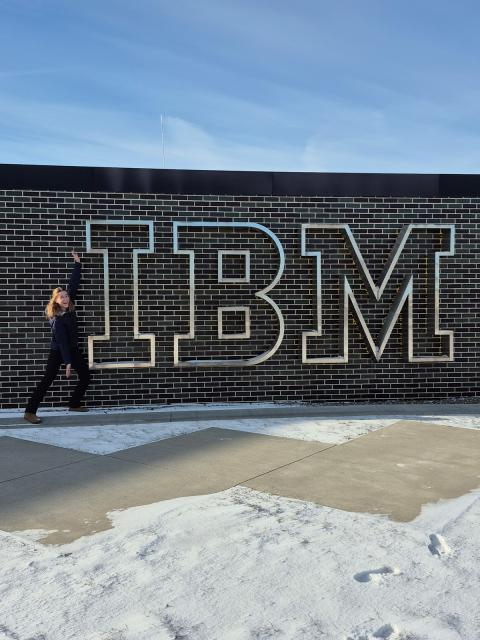
At IBM in Rochester, Minnesota, UW-Stout computer science senior Amber Kuhn is completing her cooperative learning experience as a hardware development intern.

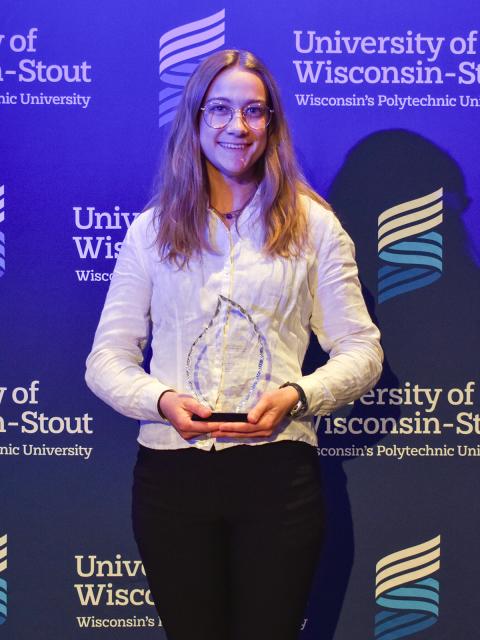
Kuhn, of Andover, Minnesota, was one of 24 UW-Stout students who received the university’s 2026 Outstanding Cooperative Education and Internship Program Student of the Year Award.
She graduates in May 2026 and has accepted a full-time hardware development position at IBM, where she plans to continue growing her skills in industry while gaining deeper experience in large-scale systems and engineering practices, she said.
“This internship has reinforced my interest in the field of computer science and confirmed that I am on the right career path. I am grateful for the support from both UW-Stout and IBM, and I am excited to continue learning and contributing as I move into a full-time role.”
What interests you most about computer science?
What interests me most about computer science is the combination of problem-solving, logic and creativity. I enjoy building systems that have real-world applications, especially when software interfaces directly with hardware. I find it especially rewarding to take abstract concepts and turn them into functional, reliable solutions.
How do you hope to make an impact in your field?
I hope to make an impact by contributing to well-designed, reliable systems and by building tools that improve efficiency and reduce errors for both engineers and users.
Long-term, I want to be involved in work that bridges software and hardware and that has tangible, real-world impact. Enterprise computing systems are a strong example of software and hardware with significant real-world impact.
Large-scale server hardware, combined with low-level software, firmware, and automation tools, supports industries such as health care, finance, government, cloud services and research. These systems are critical because they must be highly reliable, secure, and scalable to support essential services and large volumes of data.
Through my internship experience, I’ve seen how internal software tools and automation can make a meaningful difference by streamlining workflows, reducing configuration errors, and improving system reliability. While these tools may not be customer-facing, they have a broad impact by supporting the engineers and technicians who build and maintain complex systems.
I hope to contribute to fields that rely on dependable infrastructure and high-performance systems, particularly enterprise computing and hardware-software integration. I am especially interested in building tools and systems that support technical teams and help ensure that critical technologies people rely on every day function reliably and efficiently.
What are your main roles as an intern with IBM?
My main roles include supporting hardware development and testing, assisting with automation and tooling, working with cross-functional teams, and contributing to projects that improve reliability, usability and efficiency of engineering workflows.
One project I worked on involved developing and improving internal tools to automate test setup and configuration, making bench setups more consistent and reducing manual errors. I also assisted with hardware-related testing and documentation efforts that helped streamline workflows for engineers and technicians.
These projects were primarily designed to support enterprise computing and infrastructure development. While the tools and testing work I contributed to were internal-facing, they directly support hardware platforms that are used across many industries, including health care, finance, cloud computing, government and research.
My team’s work fits into a much larger system at IBM, where every part of the supply chain, from hardware design and manufacturing to testing, integration, and deployment, plays a critical role in delivering reliable systems. Each team contributes a piece that ensures these platforms can meet the needs of a wide range of industries and use cases.
By improving test automation, configuration consistency, and documentation, the work helps ensure that hardware systems are reliable, scalable, and ready for deployment in environments where downtime or errors can have serious consequences. In that sense, the impact extends beyond a single field and supports industries that rely on high-performance, dependable computing systems to operate critical applications.
The projects also supported engineering and technical teams directly, helping them work more efficiently and accurately, which ultimately improves the quality of the systems delivered to customers across these industries.
What do you enjoy most about your internship?
What I enjoy most is working on meaningful, real-world problems alongside experienced engineers. I appreciate being trusted with responsibility and having the opportunity to learn how large-scale systems are designed, tested and maintained in an industry environment.
What is challenging about your internship, and how do you face those challenges?
The most challenging aspect is the complexity of the systems and the steep learning curve that comes with enterprise-level hardware and software integration.
I face these challenges by asking questions, seeking feedback, reviewing documentation and breaking problems down into manageable pieces. I’ve learned to be persistent and proactive when troubleshooting.
How will your courses and experiences at Stout help you make an impact in your career?
UW-Stout’s hands-on, applied learning approach has been especially valuable. Courses in software development, databases, and web programming, along with project-based assignments, have prepared me to work on real systems.
Projects where I designed full applications from backend to frontend stand out the most, as they closely mirror the work I’ve done during my internship.
A strong example of this preparation is my capstone project, Rock the Wall, which I completed the semester before starting my internship. Rock the Wall is a full-stack, web-based route management system designed for the Stout Adventures Rock Climbing Wall. The application was created to replace a manual Excel-based process used to track climbing routes and employee hours, which was time-consuming, error-prone and difficult to manage collaboratively.
The application serves multiple end users. Climbers can view currently set routes, track their progress, see leaderboards and climbing rankings, and leave feedback on routes. Employees can add, edit, or retire routes and log their setting hours, while managers have additional administrative tools to manage user roles and oversee wall activity. The system was built using JavaScript and PrimeVue for the frontend, Firebase for authentication, PostgreSQL for the database and GitHub for version control.
Designing Rock the Wall required me to think critically about user roles, data modeling, authentication, and usability, skills that directly transferred to my internship work. Building a complete application from backend to frontend gave me confidence working on production-level systems and reinforced the importance of clean architecture, collaboration and user-centered design. This experience has been foundational in helping me contribute meaningfully in a professional software development setting.