





John Deere machinery has been recognizable for its distinctive green color for more than a century. Student and faculty researchers at UW-Stout are working to ensure that John Deere is also known for a different kind of green: sustainability.
Led by Professor Wei Zheng, student research assistants in the B.S. plastics engineering program have been working over the past two academic years to study how John Deere might be able to use recycled plastic polymers to manufacture vehicles.
Zheng is an active member of the Society of Plastics Engineers, and it was through that organization that she formed connections with engineers from John Deere, which is based in Moline, Illinois. The relationship led to a research contract between the Fortune 500 company and UW-Stout, which was facilitated by the university’s Office of Corporate Relations & Economic Engagement.
Beginning in August 2024, students and faculty have tested and molded batches of different types of recycled plastic to see if they meet the manufacturer’s needs.
“John Deere is asking two key questions,” Zheng said. “Can recycled polymers be used to manufacture these parts? And can those parts meet performance requirements?”
The research is part of the company’s commitment to incorporating more recyclable and renewable materials into its products so it can be ahead of the curve in its industry, she said.
Students create, test samples
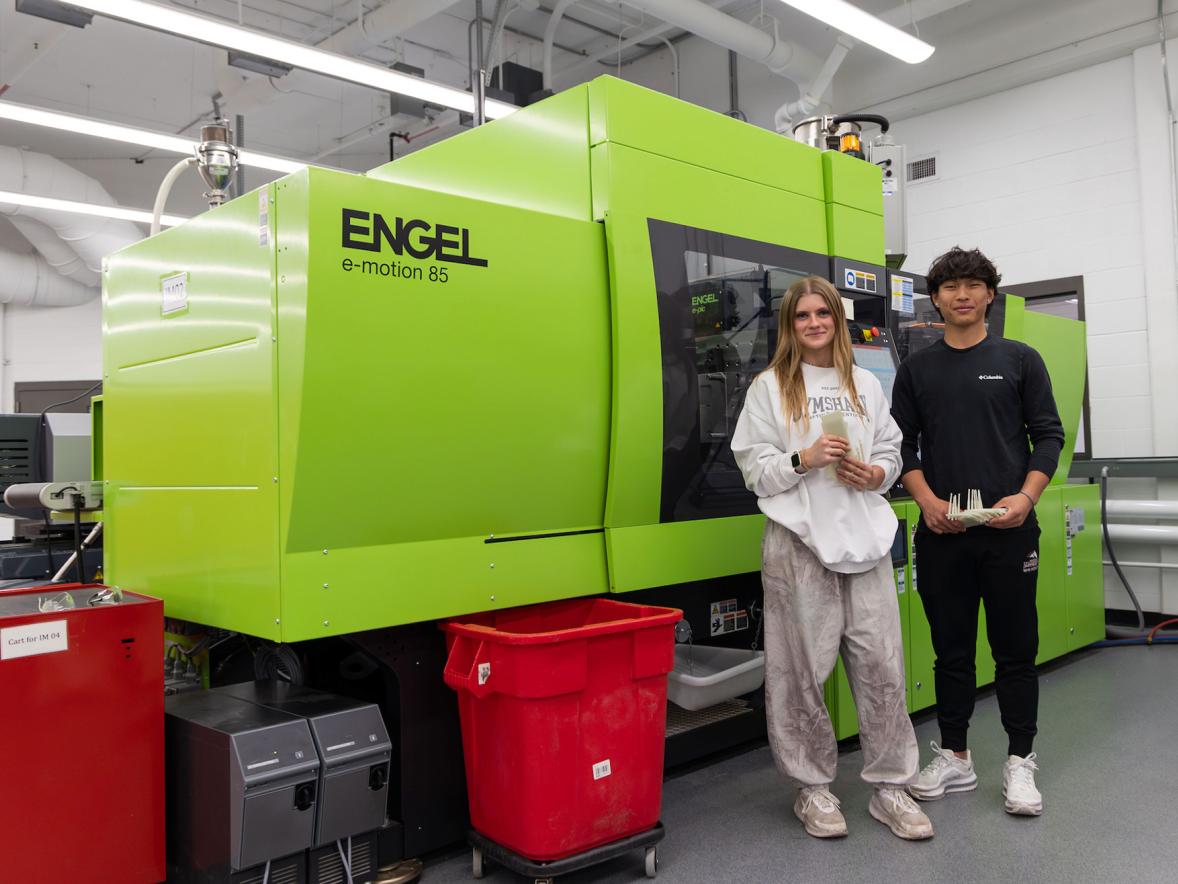
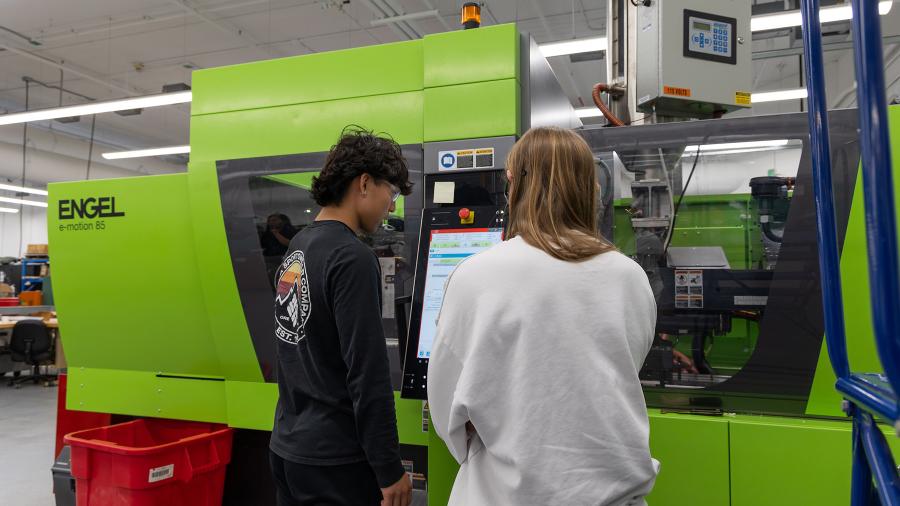
This semester, two student research assistants have worked on the project. One of them, junior Stephanie Kuhn, explained that the process begins with pellets of different types of recycled plastic polymer that are fed into a massive injection molding machine in the Plastics Engineering Lab inside Jarvis Hall Technology Wing.
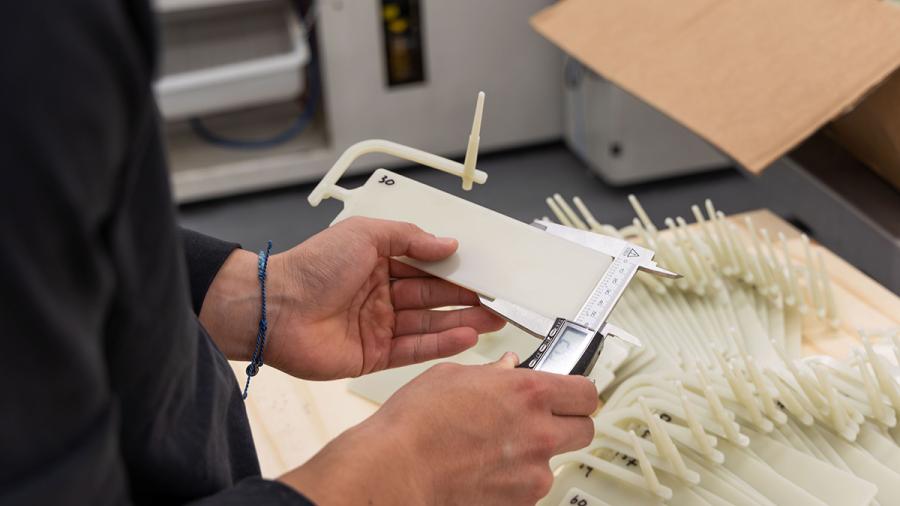
Heat and friction melt the pellets, which are forced into a mold where they take the desired shape. Once completed, these pieces are cut precisely into various testing specimens by Instrument Shop Supervisor John Buss, who also assists with machine-related issues.
Next, students subject the specimens to a range of tests, including evaluating their short- and long-term mechanical behavior under stress, as well as their thermal and physical properties to assess overall performance.
Kuhn, who is pursuing a double major in B.S. plastics engineering and B.S. mechanical engineering, said having an opportunity to do this kind of work as an undergraduate is what attracted her to UW-Stout.
“I just love being able to use all the machines hands-on. It helps being able to see and use the equipment,” Kuhn said. While already familiar with the injection units and testing equipment from her coursework, taking part in the research helped Kuhn better understand how the equipment operates, reinforcing what she learned.
Likewise, the importance of the research has been highlighted by Kuhn’s classwork, which has emphasized the need for increasing the use of recyclable plastics. “It has definitely opened my eyes that we need to learn to be more sustainable,” she said. “If John Deere begins to use this, hopefully other manufacturers will, too.”
This semester’s other research assistant, Ryan Xu, a Menomonie High School senior who is already taking classes at UW-Stout, said he appreciates the applied nature of the project, including being able to use advanced equipment and analyze data.
Professor Adam Kramschuster has also helped with the John Deere research project by setting up, optimizing and troubleshooting the injection molding process for manufacturing the samples. This work has involved training the student research assistants and helping with the machine during the molding trials.
“I love working with students. It’s why I am here, and I enjoy it when they learn and take responsibility as their knowledge base grows,” Kramschuster said.
“Our labs are exceptional,” he continued, “and the opportunity to use them for industry projects is ideal in that the students get even more real-world training during their undergraduate experience.”
Sustainability key to professor’s research
The kind of research happening in the Plastics Engineering Lab isn’t uncommon at UW-Stout. In fact, applied learning and research are among the pillars of the university’s polytechnic identity, which also include business and industry collaboration and career-focused experience – all three of which are part of the John Deere project.
Zheng noted that two of her prior research assistants leveraged their experience on the project to find jobs in the plastics industry at EVCO and Phillips Medisize. “This project helped them to solidify their injection molding and material testing skills, giving them a clear advantage in the job market,” she said.
The research, she added, will continue through at least this August. “John Deere is quite pleased with the results we have generated so far,” she said. “John Deere has been very supportive throughout the process, including providing Stout the plaque mold and materials, as well as sharing their technical expertise. They even connected us with material suppliers and molders.”
Zheng’s work on behalf of John Deere complements her ongoing research focus on sustainability. During the 2024-25 academic year, Zheng conducted sabbatical research in advancing sustainability in the field of plastics, focusing on the biodegradation of plastic materials and the recycling of thermosetting materials. Typically, thermoset plastics have undergone a curing process that prevents them from being remelted or reshaped, posing a challenge in the recycling process. However, plastics engineers and chemists researching the reverse crosslinking process are developing ways to break the chemical bonds, allowing thermosetting plastics to be recycled. Part of Zheng’s research focused on finding ways to reverse the process, increasing the recyclability of this kind of plastic.