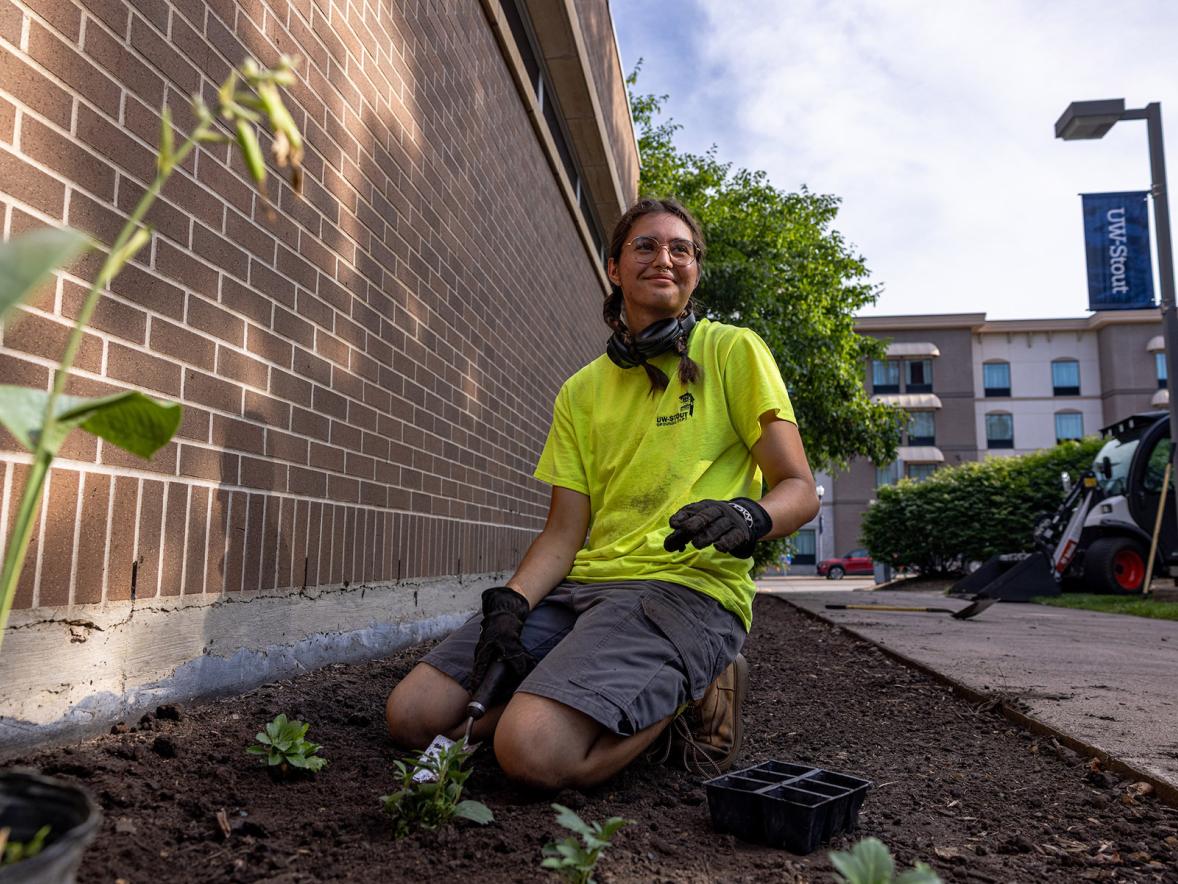






A UW-Stout Polytechnic student is applying personal enthusiasm and academic experience to an on-campus summer job designing and creating landscapes that add native plants to the university grounds.
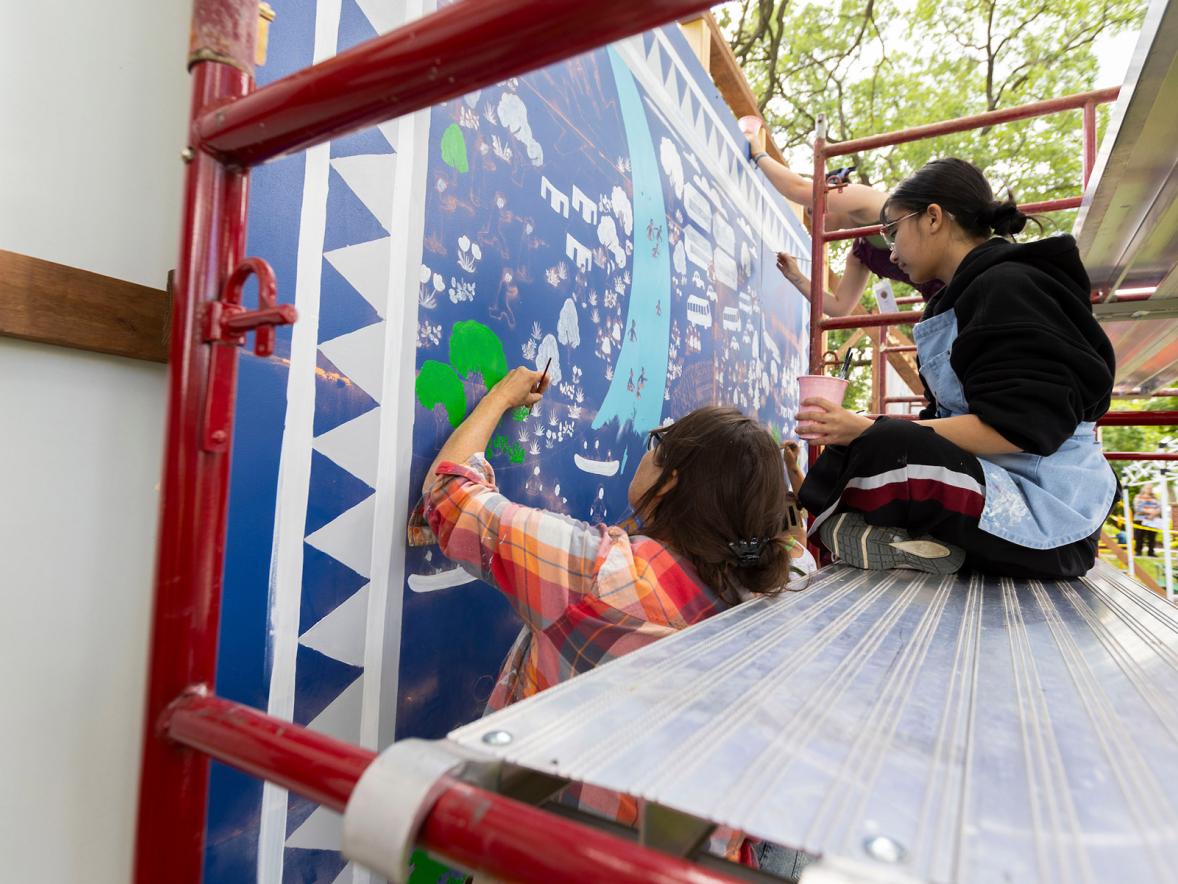
The landscapes will enhance the beauty and sustainability of several campus locations, including the new mural that showcases UW-Stout Polytechnic’s history on the exterior of the Administration Building, facing Alumni Clock Tower Plaza.
Pollinator-friendly native plants such as showy goldenrod and nodding pink onion have taken root this summer thanks to the green thumb of B.S. biochemistry and molecular biology major Adam Bayerl.
The student-led effort is an example of the university’s polytechnic identity, which emphasizes applied learning and research that brings students out of the classroom and into career-focused experiences.
“It’s definitely a passion project,” said Bayerl, a sophomore from Green Bay. “I have a personal vested interest in ecology. While it’s not my major, it’s definitely something my generation should start concerning itself with, considering how much it affects us, our well-being and the future in general.”
The project grew out of Bayerl’s interest in sustainability as well as inspiration from Assistant Professor Cassondra Vernier. In Vernier’s molecular cell biology course, Bayerl analyzed the gut microbiomes of bees, and Vernier suggested he could use the same technique to analyze soil microbiomes around campus. Bayerl learned that native plants improve soil in part by helping microorganisms thrive. Native plants are frequently more drought- and sun-tolerant than nonnative plants and are typically less expensive because they are easier for nurseries to grow.
In addition, Bayerl said, plants native to prairie biomes – which once covered parts of western Wisconsin – are particularly well-known for their ability to trap carbon and filter environmental pollutants. Ideally, once established, these plants will require less water and labor to maintain.
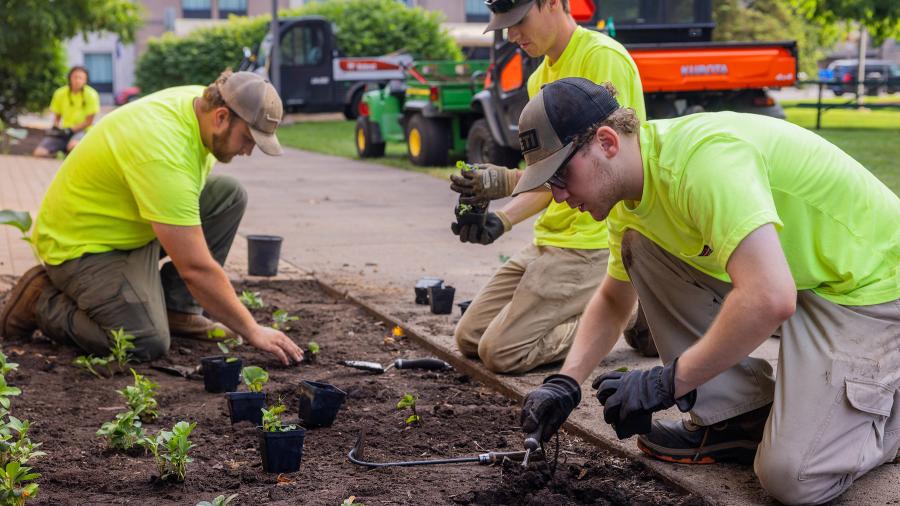
Idea becomes reality
Last spring, Bayerl prepared a proposal to create a native plant garden outside North Hall, where he lived at the time. The idea reached Zenon Smolarek, associate director of Facilities Management, and Nolan Dowd, assistant grounds supervisor, who met with Bayerl.

“He had a design, and we talked about native plants and drought resistance,” Smolarek said. “He came very well-prepared and was articulate. He really had a great attitude about the whole thing. I was impressed with what Adam had to say.”
Smolarek asked the student if there were other places on campus he had his eye on, while Dowd encouraged him to apply for a summer job as a groundskeeper – which he did.
First, Bayerl was asked to design a garden bed in front of Furlong Gallery by the Applied Arts Building. Then a spot alongside North Hall joined the list. Next came a mulch bed outside Bowman Hall and several spaces near the Administration Building, including beds by the new mural. In all, Bayerl has worked on plantings in eight locations on campus, six of which were entirely or partly composed of native plants.
“It’s quite a lot more than planned,” Bayerl acknowledged with a smile.
“Adam proceeded to design most all of our plantings for the summer,” Smolarek said. “We’ve bought over 1,500 plants, and Adam has been primarily planting them along with a couple of the other limited-term employees.”
The projects have allowed Bayerl to step into a leadership role. In addition to typical summer groundskeeping tasks such as digging up mulch beds and sowing grass seed, he has been able to help his landscape ideas come to life by planting native species such as smooth aster, wild ginger and Lady in Red ferns.
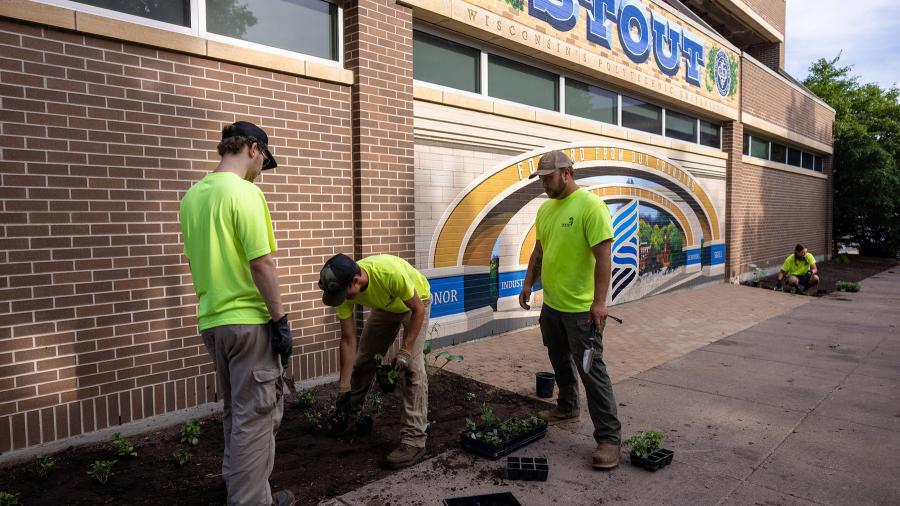
Plantings enhance new mural
On a recent muggy summer morning, Bayerl and other groundskeepers carefully placed scores of plants in beds that flank the new mural on the east side of the Administration Building. The artwork, designed by California muralist Tom Seibert and painted by volunteers in June, was created as part of the communitywide Murals in Menomonie event.
The mural encompasses numerous elements from the institution’s 135-year history, including the logos of both the Stout Institute (1908-55) and Stout State University (1955-64), the contemporary triple-banded “S” logo, and pillars bearing the institution’s enduring values: Honor, Industry, Learning and Skill. A panoramic depiction of campus landmarks is framed by painted archways bearing the phrases “Forward from our founding” and “Forever to our future.”
And when it comes to the future, Bayerl has further dreams for helping native plants flourish across campus.
“I hope to incorporate more natural features, especially with a focus on pollinators – creating habitats for all the animals that you see around campus,” he said.
Smolarek said he’s impressed with Bayerl’s work ethic and imagination. “I’m curious what he’s going to think of next,” Smolarek said. “I’m sure the gears are turning, I’m sure he’s picking out other spots, other plants he wants to try. I’m very impressed with him.”