





Just four years after it was created, the UW-Stout Bachelor of Science cybersecurity program ranks as one of the best in the nation, recently landing at No. 14 among the Top 25 programs in the United States, according to Programs.com.
The cybersecurity program also was placed No. 21 among the Most Affordable Cybersecurity Bachelor’s Programs in separate rankings compiled by Cybersecurity Guide.
The accolades arrived just as cybersecurity students are making another strong showing in the annual Collegiate Cyber Defense Competition, earning the top spot in Wisconsin for the sixth time in seven years and placing second among teams from five states in a regional qualifier. Next, the UW-Stout team will compete at the Midwest Regional CCDC on March 20-21 at Purdue University Northwest in Hammond, Indiana.
UW-Stout students also delivered an outstanding performance last fall in the National Cyber League (NCL) competition, which includes more than 9,000 students nationwide. The five-member UW-Stout team placed 43rd among nearly 800 institutions in the competition.
And in December, UW-Stout hosted its second annual Capture the Flag event, a competitive simulation in which participants solve security problems to gain points. The competition drew more than 100 participants, including students from other Universities of Wisconsin campuses, high school teachers and their students, and even students from Malaysia.
Professor Holly Yuan, program director of B.S. cybersecurity and B.S. computer networking and infrastructure engineering, points to driven, talented students as the reason for this notable string of achievements.
“I’m very proud of the students, our Stout students, because of their passion,” Yuan said. “My job is giving them the resources they need. They are self-driven.”
Last year, UW-Stout’s cybersecurity program placed No. 22 on the Best Value Cybersecurity Degree rankings by Programs.com. The most recent ranking — 14th among all U.S. cybersecurity programs — considers affordability as well as academic rigor, applied learning and the relevance of the curriculum.
That curriculum, Yuan explained, combines computer networking, computer science and applied math with cybersecurity-focused courses that explore security networking, security software and artificial intelligence in cybersecurity, all of which gives students industry-ready skills.
What really strengthens the program, she added, are its small class sizes, applied learning environment and strong industry partnerships that allow students to work on real-world projects.
“I think that combination makes the Stout program unique and strong,” Yuan said.
Competitors juggle tasks to thwart hackers
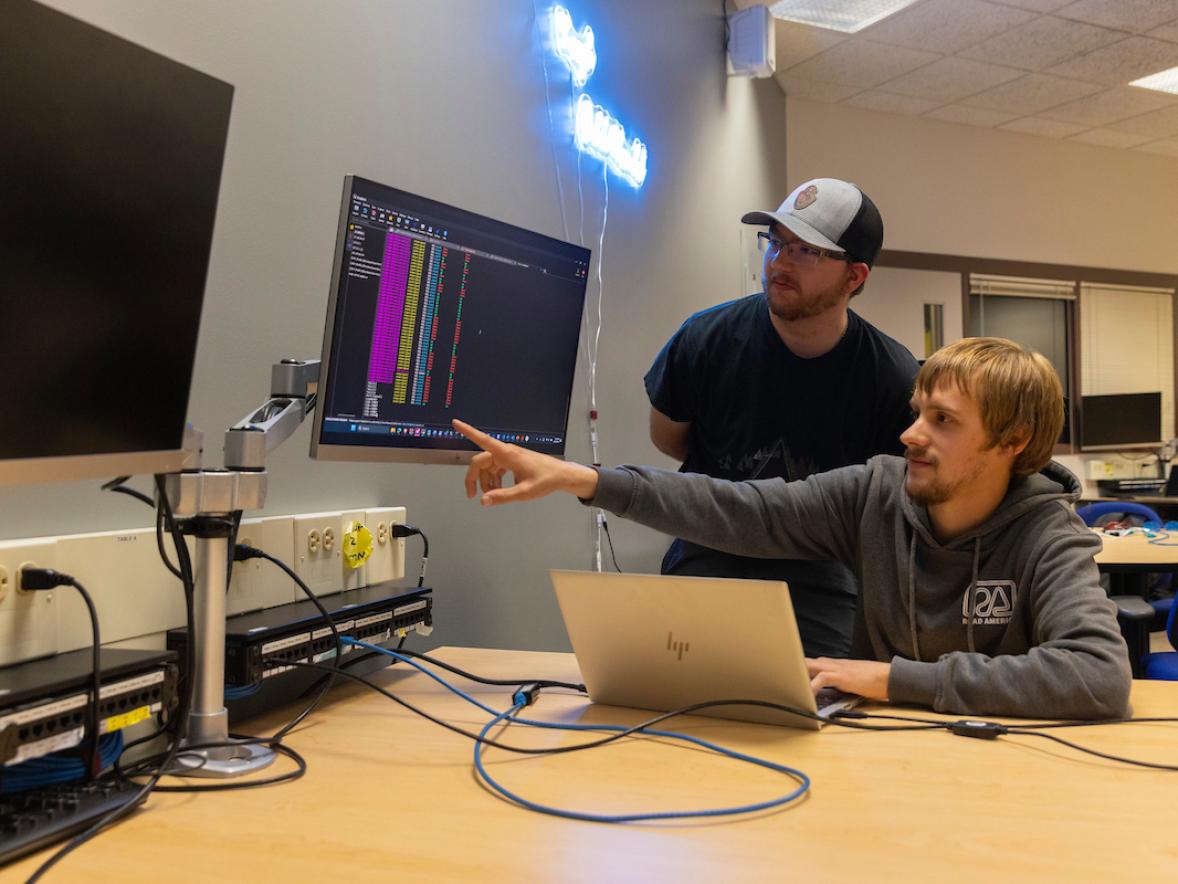
Students say the cybersecurity program excels because it offers applied learning that combines computer science, networking and security.
“Students aren’t just learning concepts; they are applying them in labs fueled by passionate instructors. The work that Holly and other professors have put into the program shows to the students,” said junior Fletcher Meyer, a cybersecurity major from Appleton, Wisconsin, and president of the Cyber@Stout student organization.
Meyer said he was drawn to UW-Stout’s cybersecurity program because of its designation as a National Center of Academic Excellence in Cybersecurity, the availability of Department of Defense scholarships, and its success in the Collegiate Cyber Defense Competition. This is Meyer’s third year taking part in CCDC, and he’s been focusing on learning more about firewall systems and teaching newcomers about Linux security.
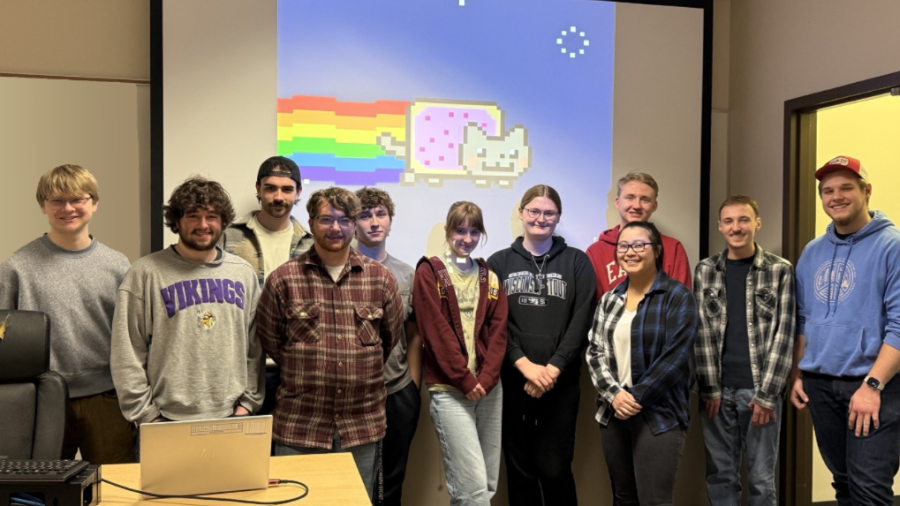
In CCDC, team members are placed in a scenario where they must defend a compromised corporate environment that includes mail servers, databases, websites, and more. “A typical CCDC competition starts with the flag drop, where all teams can suddenly enter the environment and secure these services,” Meyer explained. “What makes this flag drop so special is the fact competitors already have the knowledge their system has been hacked and must be fixed soon — otherwise the red team hackers will further compromise our systems.”
At the same time, the team must respond to simulated users facing technical difficulties while also responding to “injects,” or business memos requesting certain tasks.
“The most challenging part of the competitions for me is the mental juggling act, remaining somewhat collected while balancing troubleshooting, injects, and other requests, all while the environment is trying to burn itself up,” said senior Brett Bender, a computer networking and information technology major from Rio, Wisconsin. “There’s a unique adrenaline rush in solving high-stakes puzzles under extreme pressure, especially when you’re doing it alongside one of the most talented teams in the Midwest.”
This is Bender’s first year taking part in CCDC, and he said the experience has been both amazing and rigorous. “We practice multiple times a week in our own environment, have volunteer red team hackers test our skills outside of competition, and have frequent presentations regarding various topics that are relevant during competition,” he said.
“Between practicing, competition, and other weekly meetings, it’s obvious that we all show up with a drive for excellence,” Bender continued. “Each of us finds joy in the challenges presented, and we are constantly looking to solutions for the situations we find ourselves in during competition.”
Lab experience leads to workplace skills
These competitions, as well as educational events hosted by organizations affiliated with the program, help expand the expertise of students and prepare them for the workforce. Senior Chloe Kaneski, a cybersecurity major from Plymouth, Minnesota, interned last summer as a technical support engineer at Verkada, a security technology company.
“This role was very centered around understanding networking concepts and how their devices were connected to a client’s network,” Kaneski said. “For my future career, I believe that the skills Stout’s program has given me and the knowledge I have learned from competitions will set me up for success.”
Kaneski, who will graduate in May, is already making a mark in her field. Last semester, she helped found a campus chapter of Women in Cybersecurity (WiCyS), which has hundreds of student and professional chapters worldwide, and she now serves as the organization’s president. “We are hoping that we can make a change for both current and future women in cybersecurity at Stout,” Kaneski said.
Sophomore Tram Nguyen of Vietnam is also involved WiCyS, and she received a scholarship to attend the Women in Cybersecurity Conference in Washington, D.C., in March. While Nguyen is majoring in computer networking and infrastructure engineering, she said that program is strongly connected to cybersecurity.
“Security is no longer separate from networking. It is embedded in infrastructure design, authentication and system architecture. That integration really drew me in,” she said.
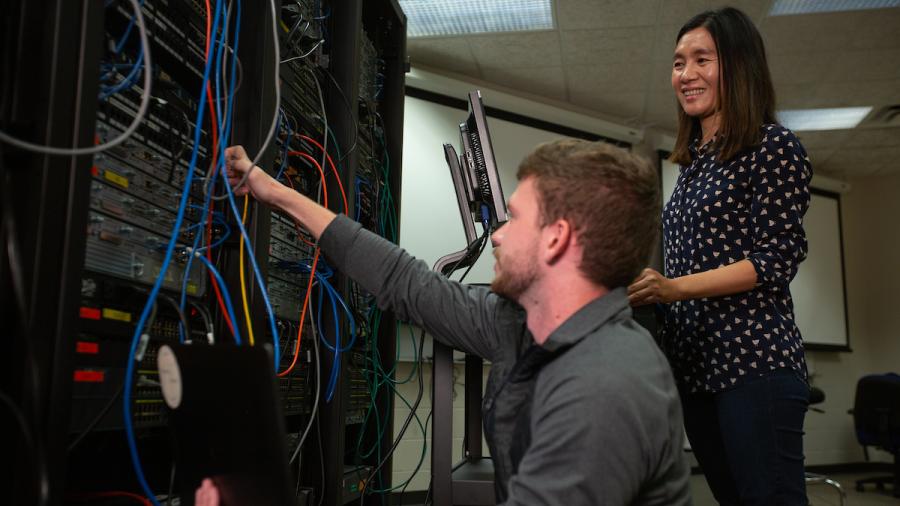
Nguyen said being able to work directly with CNIT lab equipment helped prepare her for a network support internship with the City of Eau Claire. “Being able to rack equipment, cable switches, configure real devices, and troubleshoot physical connections builds practical confidence,” she said. “Those skills translate directly into industry roles. The combination of theory and real-device experience makes the program strong and career-focused.”
Cybersecurity degree, internships underscore renewed designation as national cybersecurity center
Continue ReadingProgram has notable credentials, reach
UW-Stout is designated as a National Center of Academic Excellence in Cybersecurity through the 2028 academic year. UW-Stout was the first four-year university in the state to receive this designation.
The cybersecurity program is also recognized as a Cisco Certified Networking Academy, an AWS Certified Academy, a Palo Alto Cybersecurity Academy, and a Microsoft Certified IT Academy. Real-world lab experiences and courses are taught by faculty members with advanced IT industry credentials.
In addition to serving as cybersecurity program director, Yuan is also founding director of UW-Stout’s Cybersecurity Research and Outreach Center, which promotes cybersecurity research, education and workforce needs for the state of Wisconsin. While she is quick to laud her students and their success, she has earned honors of her own. Among other things, in 2024 she received the Visionary Academic Leadership Award at the 14th annual Cyber Security Summit in Minneapolis.
Cybersecurity program director receives national Visionary Academic Leadership Award
Continue ReadingLast fall, she was selected by the U.S. State Department for the Fulbright Specialist Program, which sends professionals and academic experts abroad for two- to six-week project-based exchanges. In May, Yuan will travel to Malaysia for a specialist appointment in the Cybersecurity & Technological Convergence Department of the University of Kuala Lumpur. Her work will focus on cloud security and AI-driven cybersecurity, compliance frameworks and workforce skill gaps in Malaysia’s digital economy, as well as hands-on workshops in cloud security, AI-powered threat detection, digital forensics, and ethical hacking. Yuan said she will also provide faculty mentorship and curriculum development.
The connection between UW-Stout and the University of Kuala Lumpur was formed several years ago when Yuan first traveled to Malaysia thanks to a U.S. State Department grant obtained with the help of UW-Stout’s Office of International Education. “They made me feel so honored and welcomed, I couldn’t wait to go back!” Yuan said. “I’m super excited to strengthen the relationship between the two schools.”