



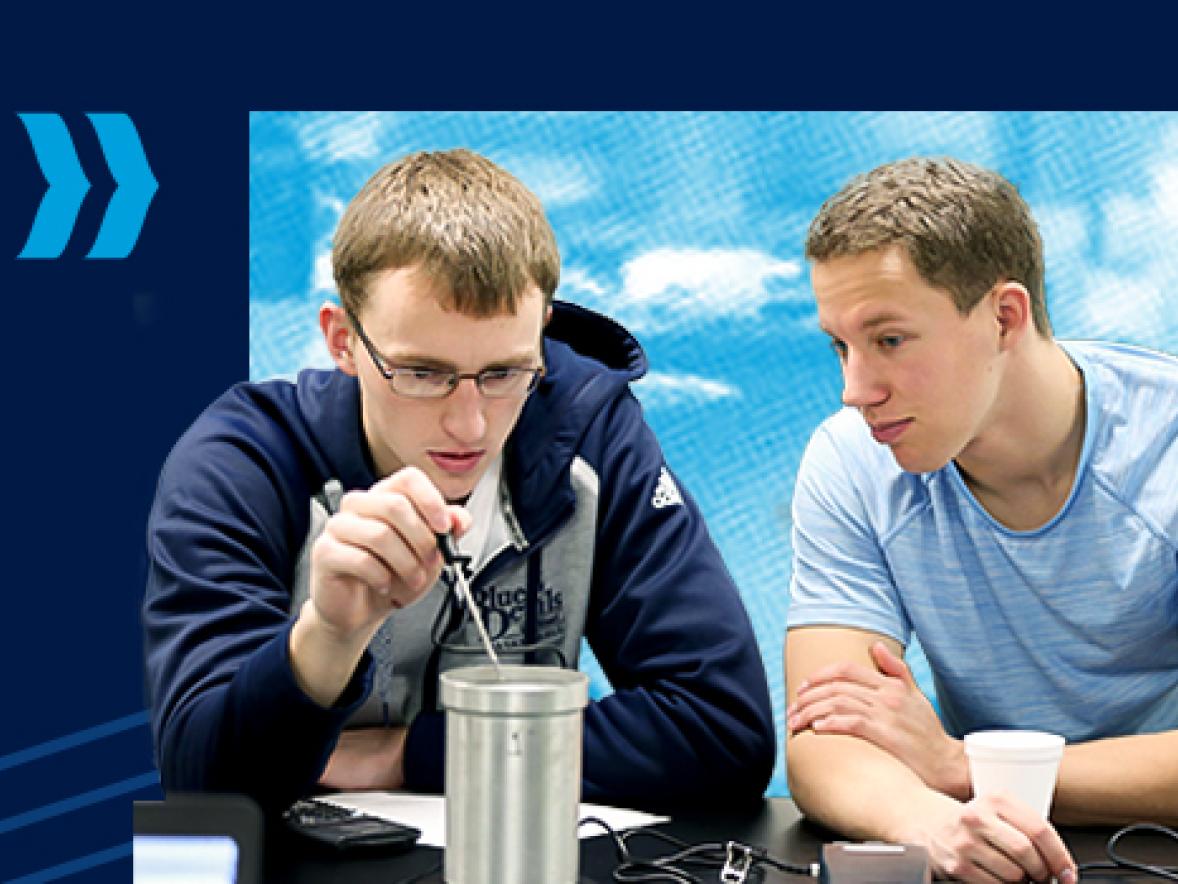
Improving Water Use in Dry Bean Production
The Crop per Drop Research Experience for Undergraduates (REU) is a collaborative research project between UW-Stout and UW-River Falls aimed at understanding and improving water use in dry bean production. The team will study the relationship between soil type, irrigation practices, crop quality and yield in the field and greenhouse. Student researchers will
- incorporate crop images, sensor data, mathematical models, and artificial intelligence to develop and study water use models for dry beans
- be fully involved in collecting crop information, analyzing sensor and image data, and analyzing water use models
The research team will partner with local growers to apply model information in production fields.
This hands-on experience will enable students to gain valuable skills in precision farming and data science while supporting Wisconsin agriculture. Students who participate in the Crop per Drop REU program will spend two months in beautiful Menomonie, Wisconsin, training under research mentors Keith Wojciechowski (UW Stout) and Veronica Justen (UW River Falls).
We will start accepting applications in late Fall 2026 for the Summer 2027.
Key Responsibilities
- Literature Review: Conduct comprehensive literature reviews to understand mathematical modeling of water-soil-plant interaction.
- Data Collection and Analysis: Assist in collecting, processing, and analyzing data from sensors, computer systems, and websites. Some of this data collection will take place in the field.
- Mathematical / Statistical Modeling: Fit parameters to an existing mathematical model and assist in developing a data-driven model for predicting crop yield.
- Programming: Use the Python ecosystem (NumPy, Pandas, PyTorch, etc.) to solve the problems posed by the team.
- Documentation: Maintain detailed records of research activities, experimental setups, and results. Prepare reports and documentation for research findings.
- Collaboration: Work closely with faculty mentors and fellow undergraduate researchers, participate in team meetings and research discussions and presentations.
- Presentation: Prepare and deliver presentations on research progress and findings as applicable.
Basic Qualifications:
- Completed Calculus 1 with a grade of B or better
- Willingness to learn a programming language
- Willingness to figure out how to collect and clean data from a variety of sources (sensors, websites, etc.)
- Excellent problem-solving and critical thinking skills
- Strong communication and teamwork skills
- Ability to manage a set of small problems simultaneously and bounce between helping different members of a larger research team
- Ability to work independently and take initiative
- Attention to detail and strong organizational skills
Preferred Qualifications:
- Completed a Linear Algebra course
- Experience using data science skills to solve problems in your field (economics, psychology, sociology, etc.)
- Basic programming skills (e.g. Python, C++, Java)
- Some prior research experience
REU participants receive a $5400 research stipend for the summer, in addition to free housing in UW-Stout dorms during the program, and a $450 food allowance. There is also funding support to travel to a conference to present your final research findings.